Every era of computing invented its own vocabulary. The pioneers of the mainframe era had to decode assembly mnemonics. The object-oriented era gave us classes, inheritance, and polymorphism. Now AI has handed us a new dictionary, and if you're building with it today, you're a pioneer whether you signed up for that title or not.
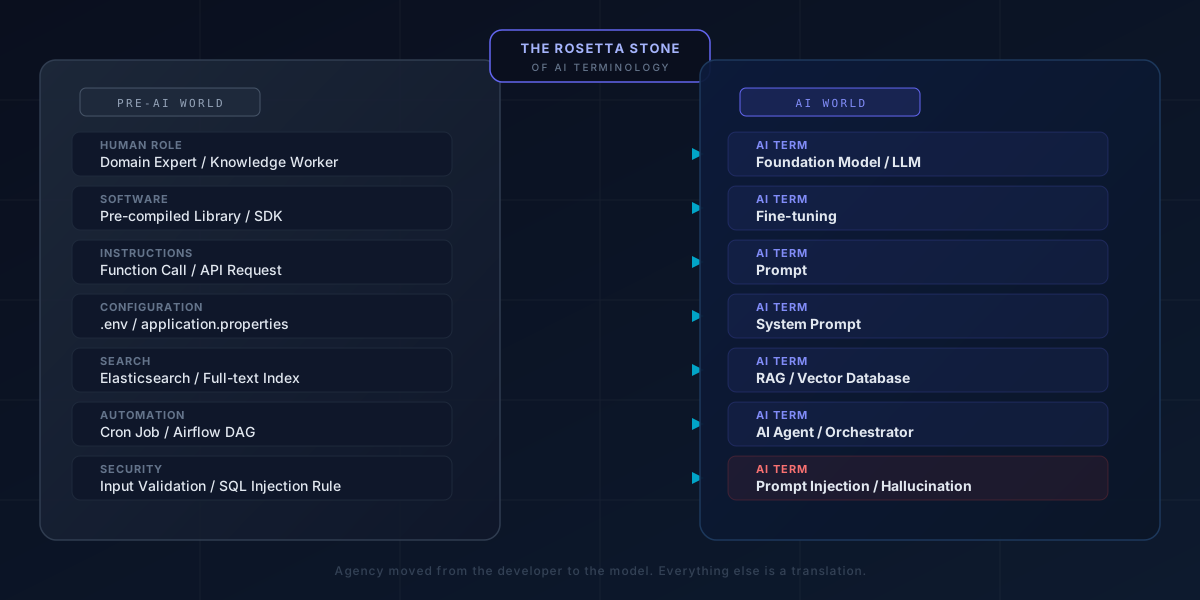
This is your Rosetta Stone. For every AI term, we give you two anchors: the human situation it mirrors, and the pre-AI software concept it most closely replaced. Use whichever column clicks for you.
| AI Term | Human Equivalent | Pre-AI Software Equivalent | What Actually Changed |
|---|---|---|---|
| Models & Training | |||
| Foundation Model / LLM | Trained domain expert / specialist knowledge worker | Pre-compiled library / black-box SDK | Before AI you hired an expert or imported a library with fixed functions. Now you licence a model with generalised reasoning and adapt it. The "library" can handle tasks it was never explicitly coded for. |
| Training | Years of study and experience | Writing & compiling the codebase | Instead of writing explicit rules, you feed the model data and let it learn the rules itself. The developer no longer authors every branch. The data does. |
| Fine-tuning | Specialised on-the-job training / apprenticeship | Forking a library / patching a dependency | A general model is adapted to a specific domain, like forking an open-source library and modifying it for your use case, except the "modification" is done with data, not code. |
| Inference | Answering a question | Runtime execution of a compiled binary | Running a trained model on new input. The direct equivalent of executing your compiled program, except the "program" was written by gradient descent, not a developer. |
| Model weights | A professional's accumulated knowledge | Compiled binary / .so / .dll file | The trained artefact you deploy. You ship weights like you used to ship executables, except weights are opaque even to their creators. |
| Prompting & Instructions | |||
| Prompt | A job brief / instruction to a colleague | Function call with arguments / API request body | Natural language replaces code as the invocation mechanism. The interface is conversational, not programmatic, but the intent is the same: tell the system what to do. |
| System prompt | Employee handbook / job description | Config file / application.properties / .env | Sets the model's persona, rules, and constraints before the user speaks. Like a config file, it defines the operating context, but it's written in prose, not key-value pairs. |
| Few-shot examples | Showing a new hire worked examples | Unit test fixtures / sample input-output pairs in a spec | Instead of writing a rule, you show the model a few examples and it generalises. The pre-AI equivalent was documenting expected behaviour in a test or spec file. |
| Chain of thought | Showing your working before giving an answer | Verbose logging / step-by-step debug trace | Asking the model to reason step-by-step before concluding. It improves accuracy for the same reason debug logs help: making the intermediate steps visible forces coherence. |
| Temperature | A person's risk appetite / creativity level | Random seed / jitter configuration | Controls output randomness. Low temperature = deterministic and safe. High temperature = creative and unpredictable. The software equivalent was setting a random seed or adding jitter to a retry interval. |
| Memory & Storage | |||
| Context window | Working memory / desk space | In-memory buffer / stack frame / RAM limit | The amount of information the model can hold and reason over in one call. Exceed it and earlier content gets dropped, exactly like a fixed-size buffer overrun, except the model silently forgets rather than crashing. |
| Embeddings | Filing something under a meaningful label | Hash function / inverted index key | Text is converted to a numeric vector so it can be compared by meaning. The pre-AI equivalent was computing a hash or building an inverted index, but those matched by exact terms, not semantics. |
| Vector database | A card catalogue organised by topic, not title | Elasticsearch / Solr / full-text search index | Stores embeddings and retrieves the most semantically similar records. Elasticsearch was the pre-AI equivalent, but it matched keywords. A vector DB matches meaning. |
| RAG (Retrieval-Augmented Generation) | Checking the reference manual before answering | DB lookup before processing / read-through cache | The model fetches relevant documents before generating a response. The software pattern is identical to a read-through cache or a pre-query enrichment step: fetch context, then compute. |
| Persistent memory | Taking notes between meetings | Database / session store (Redis, Postgres) | Information stored between sessions so the model remembers past interactions. The direct software equivalent: writing state to a database or a session cache. |
| Agents & Automation | |||
| AI Agent | An autonomous employee who plans and acts | Daemon / cron job / autonomous script | A model that plans, acts, observes results, and loops until a goal is achieved. The pre-AI equivalent was a daemon or scheduled script, but those followed hardcoded rules; an agent reasons about what to do next. |
| Orchestrator | Project manager / team coordinator | Workflow engine (Airflow, Camunda) / message broker | Coordinates multiple agents or steps toward a goal. Pre-AI this was Airflow DAGs or a BPM engine, except those required a developer to define every edge. An AI orchestrator can re-plan mid-execution. |
| Tool use / Function calling | Picking up the right tool for the job | API call / library import / subprocess invocation | The model decides at runtime which external function to call. Pre-AI, the developer hardcoded every call. Now the model reads the situation and chooses. The call sequence is emergent, not scripted. |
| Skills / Plugins / MCP tools | Professional capabilities / specialisations | Microservices / REST APIs / npm packages | Packaged capabilities the model can invoke on demand. The software equivalent: importing a library or calling a microservice, except the model selects which one to use based on context, not hardcoded logic. |
| Agentic loop | Working iteratively until a task is done | Event loop / poll-and-process while(true) loop | The model repeatedly observes → reasons → acts → checks results until complete. The structure is identical to an event loop: the difference is the decision logic inside the loop is a model, not an if/else tree. |
| MCP (Model Context Protocol) | A universal adapter / common language | OpenAPI spec / REST standard / USB-C | A standard protocol for connecting models to external tools and data sources, the OpenAPI spec of the AI agent world. Before MCP, every integration was bespoke. |
| Quality & Safety | |||
| Hallucination | No clean equivalent | No clean equivalent closest: undefined behaviour / silent data corruption |
The model produces confident, fluent, wrong output. Traditional software either crashed, threw an exception, or returned the correct answer. It didn't fabricate plausible-sounding facts. This failure mode is genuinely new, a product of the architecture itself. |
| Guardrails | Company policy / compliance rules | Input validation middleware / schema enforcement | Rules that constrain what the model will say or do. Pre-AI this was form validation and business rules middleware. Now it has to operate on open-ended natural language, which is fundamentally harder to constrain. |
| Grounding | Citing your sources / fact-checking | Foreign key constraint / referential integrity check | Anchoring model output to verified data to reduce hallucination. The software equivalent is a foreign key constraint: the output must reference something that actually exists in the source of truth. |
| Evals (Evaluation suite) | Performance review / quality assessment | Unit test suite / CI pipeline | Structured tests that measure model output quality. Harder than unit tests because output is probabilistic. You're measuring accuracy distributions and failure rates, not binary pass/fail. |
| Prompt injection | Social engineering / manipulating instructions | SQL injection / XSS / unsanitised input exploit | Malicious input that hijacks the model's instructions. The direct AI equivalent of SQL injection: the attacker smuggles commands through the data channel to override the intended behaviour. |
| Performance & Infrastructure | |||
| Token | A word or syllable | Byte / CPU instruction / billing unit | The atomic unit of model input/output. Models think, price, and rate-limit in tokens the way networks used to think in bytes and CPUs in clock cycles. |
| Latency / TTFT | How long before you get a first response | API response time / page load / p50 latency SLA | Time to First Token is the AI equivalent of time-to-first-byte. In streaming interfaces TTFT matters more than total generation time, the same perceived-performance principle as progressive page rendering. |
| Semantic search | Asking a librarian who understands context | Full-text search (Lucene / Elasticsearch) | Finds results by meaning rather than keyword match. "Car accident" finds "vehicle collision". Full-text search was the pre-AI best effort. It could match synonyms with configuration, but not true semantic similarity. |
| Multimodal | A person who can read, watch, and listen simultaneously | Multi-format parser / multimedia processing pipeline | The model accepts text, images, audio, and video in a single request. Pre-AI this required separate pipelines per media type stitched together with glue code. Now a single model handles all of them in unified context. |
The Pattern Behind Every Row
The pattern that runs through almost every row is the same shift: agency moves from the developer to the model. Before AI, a human had to anticipate every branch, write every rule, and call every function explicitly. Now the model reads context and decides, which makes it far more flexible, and also far harder to control or predict. That's why concepts like hallucination and guardrails have no clean pre-AI equivalent: the failure modes are new because the architecture is new.